
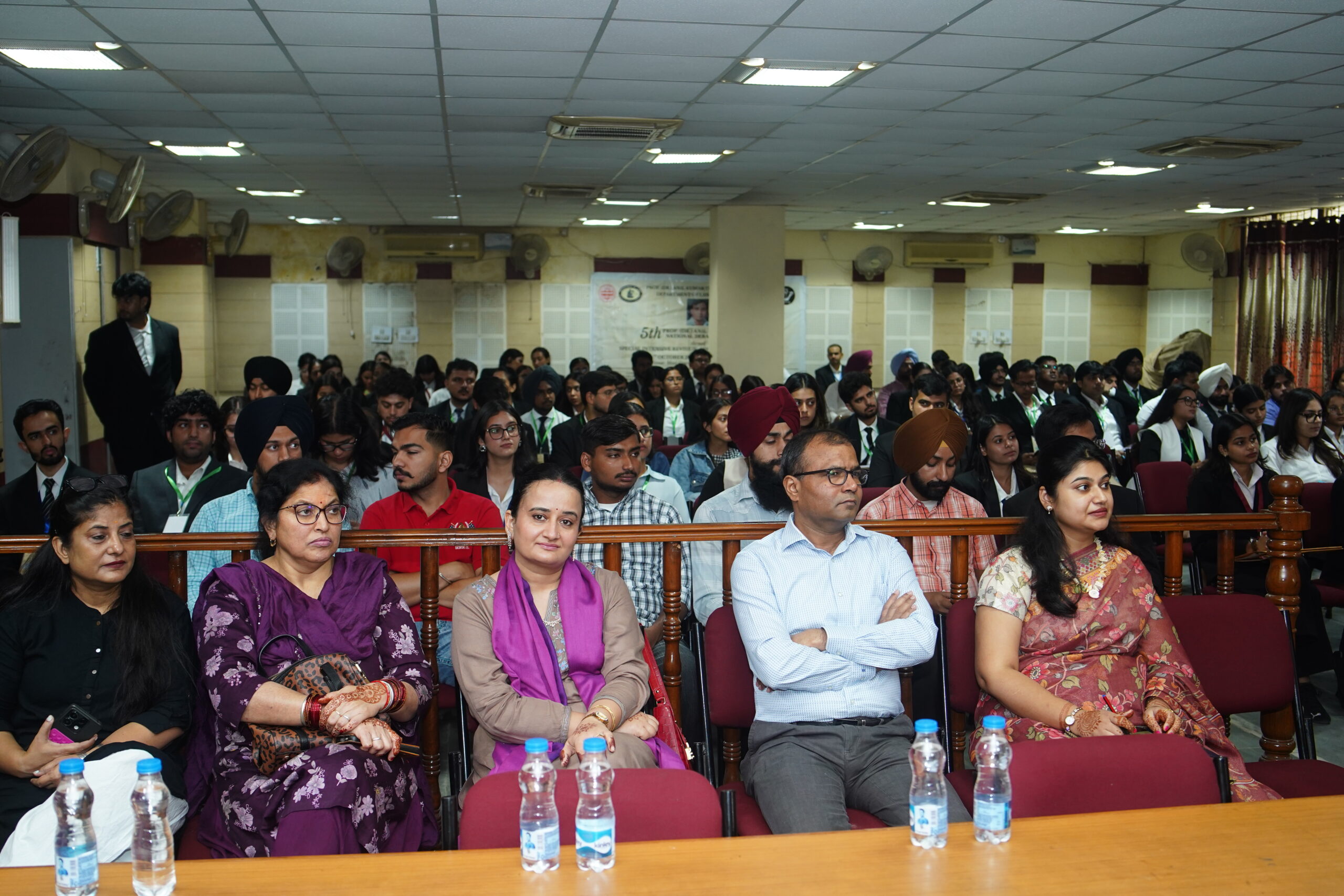
Chandigarh, October 30, 2026: More than 150 students and faculty members participated in the first National Awaaz Session organised by the Prof Anil Kumar Thakur Debating Society, Department of Laws, Panjab University in collaboration with the Museum of British Colonialism (MBC), at the department’s Moot Court Hall here on Friday. The session examined the colonial roots of India’s voting rights and explored how the legacy of British rule continues to shape the country’s laws, institutions and society.
Themed “Colonial History of Voting Rights”, the session traced the evolution of electoral rights in India under British rule, when voting was restricted to a small section of the population on the basis of property, income and education. The system of separate electorates for different communities also shaped political representation during the colonial period.
“Panjab University, Chandigarh is a heritage university having its origin from the pre- partition era as Punjab University Lahore. So is the department of laws as old as Panjab University. Prof. Dr. Anil kumar debating Society has been established in 2022 and is doing wonders by organizing multiple events of national repute from multiple streams. We are grateful to the vice chancellor of PU, our special guest Sh. Lallan baghel, faculty, staff, students and the participants and MBC.” said Prof. (Dr.) Supinder Kaur of the Department of Laws, Panjab University.
“Colonialism is the most recent chapter of our history, and yet its impact on ordinary Indians is the one we understand the least. We remember our leaders and our freedom struggle, but rarely the millions who lost their lives to famine, debt and repression. Colonial history is widely studied in our universities, but it has never moved beyond the classroom into how we remember as a nation. We still see English as superior to our own languages, which shows how deeply that legacy runs. History is not black and white, and it must be studied with honesty, not reduced to slogans. A National Day of Commemoration would give these victims the place in our memory they deserve. I urge every Indian to sign the petition at indiascolonialstory.org and help make that day a reality,” said Chandini Jaswal, India representative, Museum of British Colonisation and student of Department of Laws, Panjab University
Participants discussed how independent India departed from this restricted electoral framework by adopting universal adult franchise under its Constitution, granting citizens equal voting rights irrespective of property, income, education or social background. The session drew lively participation from students, who engaged closely with the theme and spoke candidly about how India’s colonial past still shapes its present.
Language was also one of the issues raised. One student observed that while English is useful as a language of convenience, giving it greater importance than Hindi and other Indian languages is itself a legacy of colonial rule, one that still influences how status and opportunity are measured in India.
Another student turned to the legal system, pointing out that many of India’s laws, procedures and courtroom traditions still follow the framework laid down by the British. The student argued that India’s legal system remains deeply shaped by colonial rule, and that it needs to be reviewed and reformed to reflect Indian values and the needs of its people.
The discussion showed that, for the next generation of lawyers, decolonisation is not only a chapter of history but an unfinished conversation about language, law and identity.
Students also raised questions about the colonial origins of India’s legal and political institutions. The discussion encouraged participants to examine the continuing influence of colonial history on contemporary law and society, while also reflecting on how the country remembers its past.
At the conclusion of the session, the Museum of British Colonialism invited students and faculty members to support its public petition seeking the establishment of a National Day of Commemoration for the Victims of British Colonialism in India.
The initiative seeks national recognition for the millions of Indians who lost their lives under colonial rule through famines, economic exploitation, repression and policies that deepened social and communal divisions. MBC highlighted the absence of a dedicated national day to commemorate these victims and urged participants to sign the petition at indiascolonialstory.org to help bring this history into wider public consciousness.
The session was coordinated by faculty coordinators Prof. (Dr.) Supinder Kaur and Dr. Manisha Garg, along with student coordinators Chandini Jaswal (who is also India representative of MBC) and Durgeish Damini.
About the Museum of British Colonialism
The Museum of British Colonialism (MBC) is a platform dedicated to challenging myths surrounding British colonialism and amplifying underrepresented voices and experiences from across the world. Through research, public engagement and educational initiatives, it seeks to encourage a deeper understanding of colonial histories and their continuing impact.
